

DC-Coupled Off-Grid Solution
DC-Coupled Off-Grid Solution
Designed for remote areas, islands, and communities without grid coverage, this solution converges PV and energy storage onto a common DC busbar, which is inverted in grid-forming mode through a shared PCS to supply loads. PV and storage share the inversion stage, achieving efficient independent power supply.
Core Values
Grid-Independent Efficient Power Supply Shared PCS for Lower Cost Remote Intelligent O&M
Pain Points
- ● No Grid Coverage: Remote areas, islands, or field operation sites lack access to the public grid, making electricity supply unreliable.
- ● High Cost of Diesel Power: Traditional off-grid systems rely on diesel generators, with high fuel transportation costs and volatile prices, resulting in poor economics.
- ● Poor Supply Stability: A single power source is vulnerable to faults or fuel shortages, making reliability difficult to guarantee.
Application
| Typical Scenario | Electricity Consumption Characteristics |
|---|---|
| Remote Villages and Communities | Primarily residential electricity consumption, with load concentrated in morning and evening; requires stable power supply |
| Islands and Coastal Facilities | No mainland grid, high transportation costs; requires efficient clean energy to replace diesel |
| Field Mining Sites and Bases | Both production and residential loads coexist; demand fluctuates with operation cycles |
Basic Requirements
1. Sufficient solar resources and installation space, with PV output capable of covering the main load.
2. Storage capacity must meet power supply demand during low-irradiance periods; autonomy days are determined by on-site assessment.
3. Communication conditions for remote monitoring, or acceptance of local O&M.
Capacity, configuration, and connection method shall be determined based on on-site assessment.
Solutions
Design Highlights
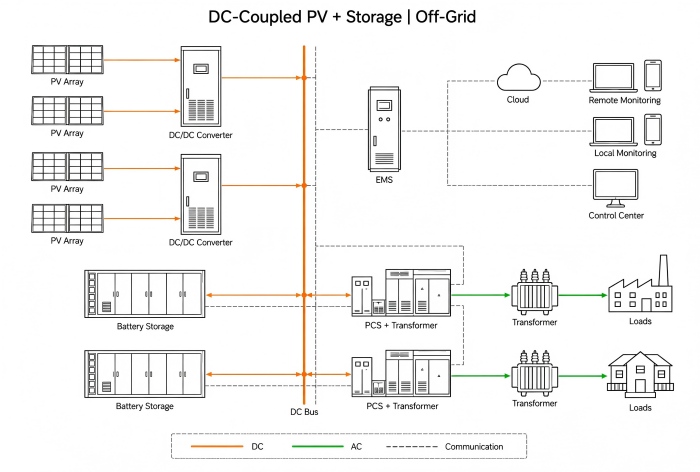
This solution adopts a DC-coupled off-grid architecture: PV is stepped up via DC/DC converters and fed into the DC busbar, while storage connects directly; the two are paralleled. The PCS operates in grid-forming mode, inverts the DC power, and supplies loads via a transformer. The EMS coordinates PV, storage, and loads to ensure power balance.
- 1. Operating Strategy: PV supplies the load first, with surplus energy charging the storage; when PV is insufficient, storage discharges; when storage is low and PV is insufficient, non-critical loads are shed by priority.
- 2. Configuration Confirmation: PV capacity is determined by resources and load, with DC/DC converters configured by PV groups; storage power and capacity are designed based on maximum load and autonomy days; the PCS must support off-grid grid-forming mode.
System Connection Architecture
- 1. Generation Side (DC): The PV array connects to DC/DC converters via DC cables, and after stepping up, feeds into the DC busbar.
- 2. Storage Side (DC): The storage battery connects directly to the busbar via DC cables, in parallel with PV.
- 3. Load Side (AC): The DC busbar is inverted in grid-forming mode by the PCS, stepped down via a transformer, and supplies loads.
- 4. Communication Side: The EMS communicates with DC/DC converters, storage, PCS, and the monitoring platform, collecting data and issuing commands, supporting multi-terminal monitoring.
Product Composition
The functions of each component are described below with reference to the topology diagram. Actual supply scope, product models, and features are subject to the project proposal.
| Component | Function |
|---|---|
| PV Array | Converts solar energy into DC electricity; the primary energy source |
| DC/DC Converter | Steps up and regulates voltage to busbar level; implements PV MPPT control |
| Storage Battery | Connects directly to the DC busbar; stores and releases electricity |
| DC Busbar | DC power aggregation point for PV and storage; the two are coupled in parallel here |
| PCS + Transformer | Core of off-grid grid forming; provides voltage and frequency reference; inverts and supplies power |
| Transformer | Steps down PCS output to the applicable load voltage level |
| Energy Management System (EMS) | Collects full-chain data, coordinates PV, storage, and loads to ensure power balance |
| Monitoring Platform | Operation monitoring, data querying, and alarm management; supports multi-terminal access |
Values
Freedom from Grid Dependence
PV and storage work in coordination to build an independent microgrid, delivering stable power in areas without a grid. Reliability depends on system configuration and O&M standards.
Improved Off-Grid Operating Efficiency
PV and storage share the PCS, and storage eliminates one conversion stage, reducing losses and making fuller use of PV electricity. Efficiency gains shall be calculated based on equipment parameters.
Reduced Long-Term Energy Costs
Replacing diesel with PV reduces fuel procurement and transportation; high equipment integration results in lower footprint and O&M costs. Economic viability shall be calculated based on solar resources and load.
Project Cases
Case 1 | Zhejiang Solar-Storage-Diesel Island Microgrid ESS Project
Project Name & Location: Zhejiang Solar-Storage-Diesel Island Microgrid Energy Storage Project, Beiji Island, Wenzhou, Zhejiang, China
Commissioning Date: January 2024
System Scale: 1.5 MW / 10 MWh Energy Storage; PV System; Diesel Generator (Backup); PV-Storage Shared DC Bus; 4-Level BMS
Detail Link: View Details →
Get a DC-Coupled Off-Grid Solution Tailored to Your Project
To assess the applicability of this solution, please provide the project location, solar resources, load types and consumption, installation site, and communication conditions. We will design the configuration and power supply scheme accordingly.
Solutions
Contact Us
E-mail: info@onbipv.com
WeChat: +86 158 0002 4197
Whatsapp: +86 158 0002 4197


 WhatsApp
 Mail inquiry