


AC-Coupled Off-Grid Solution
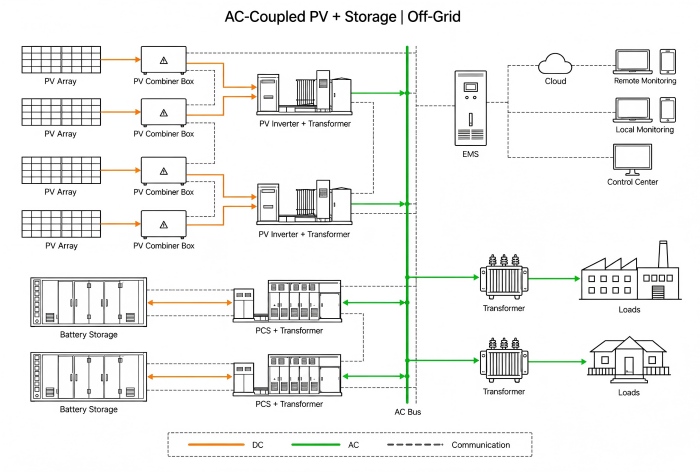
AC-Coupled Off-Grid Solution
Designed for remote areas, islands, mining sites, and independent communities without grid coverage, this solution constructs an independent microgrid power supply system by connecting PV and energy storage in parallel on the AC side. The system comprises a PV array, inverter, storage battery, PCS, EMS, and a monitoring platform. The PCS operates in grid-forming mode to provide voltage and frequency support, while PV and storage work in coordination to supply loads, delivering stable clean energy without a utility grid.
Core Values
Grid-Independent Power Supply Stable PV-Storage Coordination Remote Intelligent O&M
Pain Points
- ● No Grid Coverage: Remote areas, islands, or field operation sites lack access to the public grid, making electricity for production and daily life unreliable.
- ● High Cost of Diesel Power: Traditional off-grid systems rely on diesel generators, with high fuel transportation costs, volatile fuel prices, and poor long-term economics.
- ● Poor Supply Stability: A single power source is vulnerable to faults or fuel shortages, with large voltage and frequency fluctuations, making it difficult to guarantee reliability for critical loads.
- ● Difficult O&M Management: Sites are remote, resulting in high manual inspection costs and slow response; equipment status lacks centralized monitoring, and faults are detected late.
Applicable Scenarios
| Typical Scenario | Electricity Consumption Characteristics |
|---|---|
| Remote Villages and Communities | Primarily residential electricity consumption, with load concentrated in morning and evening; requires stable baseline power supply |
| Islands and Coastal Facilities | No mainland grid connection, high transportation costs; requires clean energy to replace diesel |
| Field Mining Sites and Operation Bases | Both production and residential loads coexist; electricity demand fluctuates with operation cycles |
Basic Requirements
1. Sufficient solar resources and available installation space, with PV output capable of covering the main load.
2. Storage capacity must meet power supply demand during consecutive low-irradiance periods; autonomy days are determined by on-site assessment.
3. Communication conditions (satellite/4G, etc.) for remote monitoring, or acceptance of local O&M.
Capacity, configuration, and connection method shall be determined based on on-site assessment.
Solution Approach
Design Highlights
- 1. Operating Strategy: PV supplies the load first, with surplus energy charging the storage; when PV is insufficient, storage discharges to supplement; when storage is low and PV is insufficient, non-critical loads are shed by priority. There is no grid connection and no reverse power feed capability.
- 2. Configuration Confirmation: PV capacity is determined by solar resources and load; storage power and capacity are designed based on maximum load and autonomy days; the PCS must support off-grid grid-forming mode; transformer capacity is configured according to load level.
System Connection Architecture
- 1. Generation Side: The PV array connects to the combiner box via DC cables, and the combined output feeds the inverter; the inverter converts DC to AC and steps up the voltage via a transformer before connecting to the AC busbar.
- 2. Storage Side: The storage battery connects to the PCS via DC cables; the PCS performs bidirectional AC-DC conversion, steps up via a transformer, connects to the busbar, and provides voltage and frequency support.
- 3. Load Side: The AC busbar connects to a transformer via AC cables, stepping down the voltage to supply industrial and residential loads.
- 4. Communication Side: The EMS connects to the inverter, PCS, and monitoring platform via communication lines, collecting data and issuing commands; data is uploaded to the cloud for multi-terminal monitoring.
System Components
The functions of each component are described below with reference to the topology diagram. Actual supply scope, product models, and features are subject to the project proposal.
| Component | Function |
|---|---|
| PV Array | Converts solar energy into DC electricity; the primary energy source for off-grid systems |
| PV Combiner Box | Aggregates DC output from multiple strings, providing combining and protection functions |
| PV Inverter + Transformer | Converts DC to AC and steps up to busbar voltage; follows PCS grid parameters |
| Storage Battery | Stores electricity and releases it when PV is insufficient, ensuring continuous power supply |
| PCS + Transformer | Core of off-grid grid forming; provides voltage and frequency reference; bidirectional AC-DC conversion |
| AC Busbar | Power aggregation and distribution hub where PV, storage, and loads converge |
| Transformer | Steps down busbar voltage to the applicable load level, supplying various loads |
| Energy Management System (EMS) | Collects full-chain data, coordinates PV, storage, and loads to ensure power balance |
| Monitoring Platform | Operation monitoring, data querying, and alarm management; supports multi-terminal remote access |
Solution Value
Freedom from Grid Dependence
PV and storage work in coordination to build an independent microgrid, delivering stable power in areas without a public grid and fundamentally solving the problem of no or insufficient electricity. Reliability depends on system configuration and O&M standards.
Reduced Long-Term Energy Costs
Replacing diesel generation with PV reduces fuel procurement and transportation costs, lowering long-term operating expenses. Economic viability shall be calculated based on solar resources, load, and alternative energy prices.
Improved O&M Efficiency
The EMS and cloud monitoring enable remote monitoring and fault alarming, reducing manual inspections at remote sites and accelerating response times.
Project Cases
Case 1 | Asia 320kW PV / 500kW PCS 1MWh Microgrid ESS Project
Project Name & Location: Asia 320kW PV / 500kW PCS 1MWh Microgrid ESS Project, Asia
Commissioning Date: [To be supplemented]
System Scale: 320 kW PV Array; 500 kW PCS Inverter (integrated ATS and EMS); 1 MWh LFP Battery; Backup Diesel Generator
Detail Link: View Details →
Get a Customized Off-Grid Solution for Your Site
To assess the applicability of this solution, please provide the project location, solar resource conditions, load types and consumption, installation site, and communication conditions. We will design the system configuration and power supply scheme accordingly.
Solutions
Contact Us
E-mail: info@onbipv.com
WeChat: +86 158 0002 4197
Whatsapp: +86 158 0002 4197


 WhatsApp
 Mail inquiry

