

Residential Solar and Storage
Residential PV-Storage System Solution
Designed for residential users with rooftop or courtyard installation conditions who wish to reduce electricity costs, this solution provides a residential PV-storage system comprising a PV array, hybrid inverter, battery storage, distribution devices, and a monitoring system. The system converts solar energy into electricity and, in conjunction with storage, achieves peak-valley regulation and self-consumption, helping households reduce electricity bills.
Core Values
Self-Consumption Reduces Electricity Bills Storage Peak Shaving Enhances Autonomy Remote Monitoring for Convenient Management
Pain Points
- ● Rising Household Electricity Costs: Residential tariffs continue to adjust, increasing household expenditure, with no proactive regulation means.
- ● Low PV Self-Consumption Rate: Households with existing PV generate more electricity than they consume during daytime, with low surplus revenue, while still requiring grid purchases during evening peaks.
- ● Lack of Transparency in Energy Management: Household users struggle to monitor generation, storage, and consumption structure in real time, and cannot optimize consumption habits.
Application
| Typical Scenario | Electricity Consumption Characteristics |
|---|---|
| Detached Houses and Villas | Have rooftop or courtyard installation space, high electricity consumption, occupied during daytime |
| Urban Apartments and Top-Floor Residents | Have rooftop or balcony installation conditions, significant peak-valley consumption differences |
| Houses in Grid-Unstable Areas | Occasional grid outages, critical loads to be secured, seeking to enhance autonomy |
Basic Requirements
1. Rooftop, balcony, or courtyard space suitable for PV installation, with adequate orientation;
2. Distribution system with grid connection conditions, and the local utility permits residential PV-storage grid connection;
3. WiFi or Ethernet communication conditions for data upload and remote monitoring.
PV capacity, storage configuration, and connection method shall be determined based on on-site assessment.
Solutions
Design Highlights
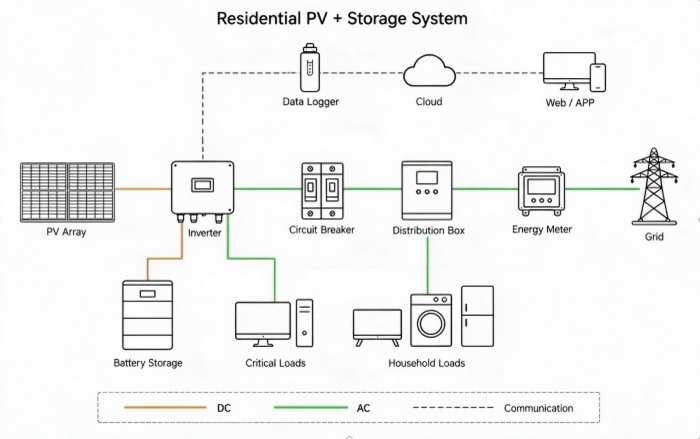
The system adopts a hybrid inverter architecture. The PV array and battery storage connect to the inverter via DC respectively; the inverter outputs AC electricity, with one circuit directly supplying critical loads and another circuit supplying household loads via a circuit breaker and distribution box, and connecting to the grid via an electricity meter. A data logger collects real-time operating data and uploads it to the cloud; users can monitor remotely via Web and APP.
- 1. Operating Strategy: Self-consumption is the priority principle; PV generation supplies household loads first; when generation exceeds load, it charges the battery; surplus electricity may be fed into the grid according to local policies. During evenings or low sunlight, the battery discharges to reduce peak-period grid purchases; when the battery is low, the grid supplements supply.
- 2. Configuration Confirmation: PV capacity is determined based on installation area, household electricity consumption, and load profile; storage capacity is determined based on consumption peak-valley spread and installation space; inverter specifications must match PV and storage capacity.
System Connection Architecture
- 1. PV DC Connection: The PV array connects to the DC side of the hybrid inverter via DC cables.
- 2. Storage DC Connection: The battery storage connects to the inverter via DC cables, enabling charge/discharge interaction.
- 3. AC Distribution Connection: The inverter outputs AC electricity, which connects to the distribution box via a circuit breaker, supplies household loads, and connects to the grid via an electricity meter.
- 4. Critical Load Connection: A separate circuit is drawn from the inverter AC side to supply critical loads, independent of the household load circuit.
- 5. Monitoring and Communication Connection: The inverter connects to the data logger, uploading data to the cloud; users view remotely via Web and APP.
System Components
The functions of each component are described below with reference to the topology diagram. Actual supply scope, product models, and features are subject to the project proposal.
| Component | Function |
|---|---|
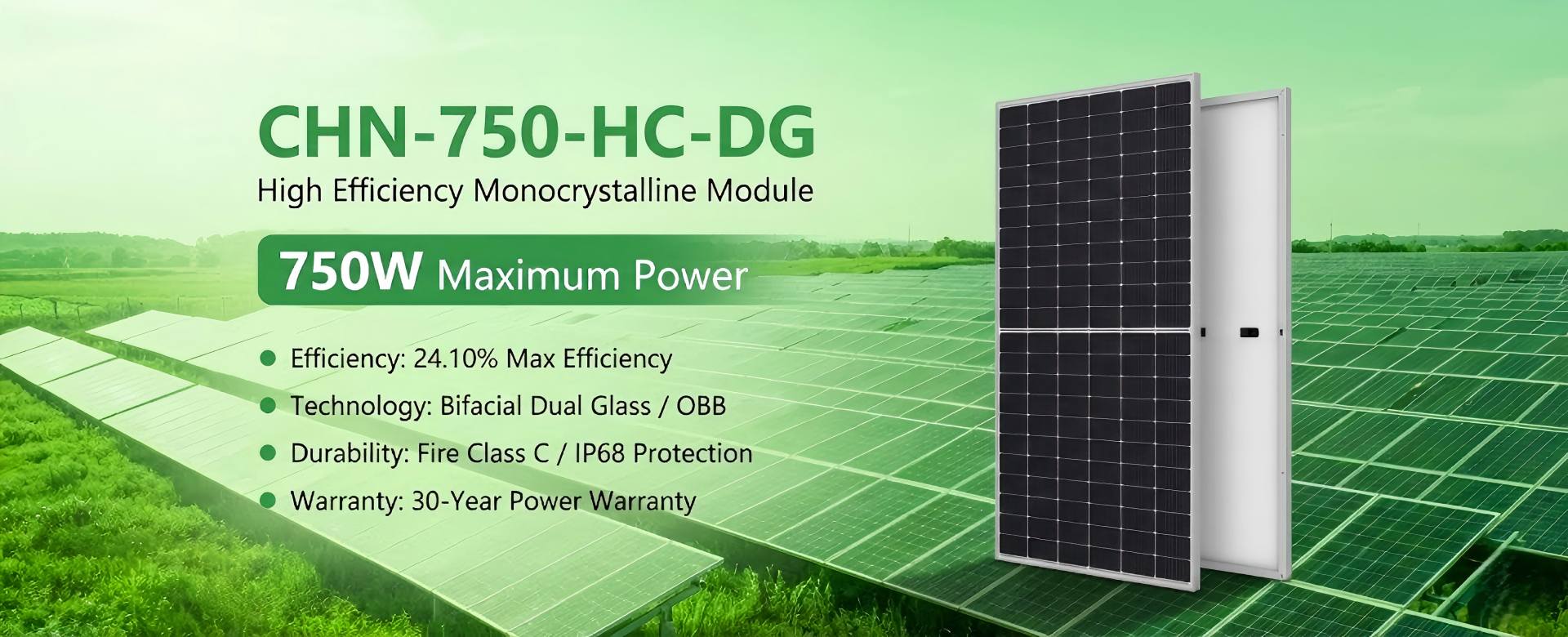
| PV Array | Converts solar energy into DC electricity; the system's generation source |
| Hybrid Inverter | Connects to both PV and battery simultaneously, achieving AC-DC conversion and charge/discharge control |
| Battery Storage | Stores electricity and discharges during low sunlight or peak hours for peak-valley regulation |
| Circuit Breaker | Connected in series between the inverter and distribution box, performing switching and overload protection |
| Distribution Box | Aggregates AC electricity and distributes it to household load circuits, performing distribution and protection |
| Electricity Meter | Meters electricity exchanged between the household and the grid, providing the basis for bill settlement |
| Critical Load | Important equipment directly supplied by the inverter, independent of the household load circuit |
| Household Load | Daily household electrical equipment, supplied by the distribution box |
| Utility Grid | System grid connection target; supplements supply when generation is insufficient, receives feed-in when surplus |
| Data Logger | Collects inverter operating data and uploads to the cloud; the monitoring communication hub |
| Web and APP | Provides remote monitoring interface; users can view real-time generation, storage, and consumption status |
Values
Self-Consumption Reduces Household Electricity Bills
The system prioritizes using PV generation to meet household consumption, with surplus electricity stored in the battery and released during evening peaks, reducing grid purchases. Actual savings depend on installed capacity, electricity consumption, tariffs, and self-consumption ratio, and shall be calculated based on actual data.
Storage Peak Shaving Enhances Consumption Autonomy
The battery charges during off-peak hours and discharges during peak hours, helping households regulate consumption timing and reduce grid dependence. During grid outages, if the inverter supports off-grid/backup functions and a switching device is configured, critical loads may continue to be supplied by PV and storage; specific capability must be confirmed in conjunction with the project.
Remote Monitoring for Convenient Household Management
The data logger collects real-time generation, storage, and consumption data, centrally displaying it via Web and APP; users can grasp the status without on-site inspection and detect anomalies promptly.
Project Cases
Case 1 | [To be supplemented]
Case Name: [To be supplemented]
Date: [To be supplemented]
Scale: [To be supplemented]
Detail Link: View Details →
Get a PV-Storage System Solution Tailored to Your Household
Provide the project location, rooftop or site conditions, recent electricity bills, and load data. We will assess PV capacity, storage configuration, and connection method, and provide a solution for you.
Solutions
Contact Us
E-mail: info@onbipv.com
WeChat: +86 158 0002 4197
Whatsapp: +86 158 0002 4197


 WhatsApp
 Mail inquiry