


PV Power Plants
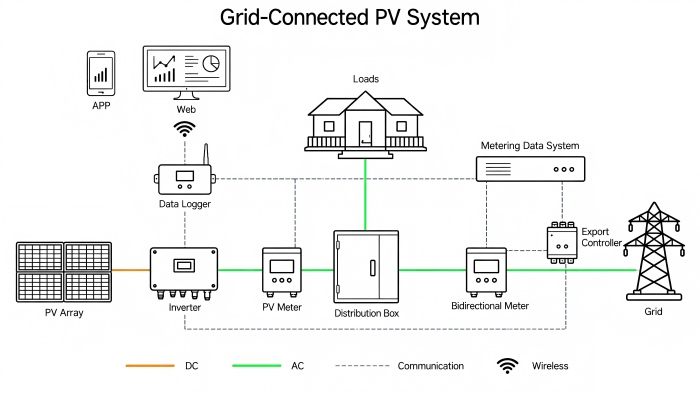
Grid-Connected PV Power Plant Solution
Designed for C&I users and public buildings with available rooftop or site space who wish to reduce electricity costs, this solution provides a grid-connected PV plant comprising a PV array, inverter, distribution box, metering devices, and a monitoring system. The system converts solar energy into AC electricity, prioritizing supply to the user's load, with surplus electricity fed into the grid according to local policies, helping users reduce electricity purchases.
Core Values
Clean Generation Reduces Energy Costs Self-Consumption Enhances Energy Autonomy Full-Chain Visualized O&M
Pain Points
- ● Rising Electricity Costs: Electricity expenditure accounts for a significant proportion of operating costs for C&I users, with no effective means to reduce grid purchases.
- ● Idle Rooftop and Site Resources: Many factories, warehouses, and public buildings have expansive rooftops or idle sites that remain unutilized.
- ● Lack of Transparency in Energy Management: Under traditional electricity consumption models, enterprises struggle to monitor consumption structure in real time, and O&M relies on manual meter reading.
Application
| Typical Scenario | Electricity Consumption Characteristics |
|---|---|
| C&I Factory Buildings | High daytime electricity consumption, expansive rooftops, consumption coincides with PV generation periods |
| Public and Commercial Buildings | Stable daytime operating consumption, available installation space, emphasis on green image |
| Agricultural and Storage Facilities | Large available shed rooftops, stable load, seeking to reduce operating costs |
Basic Requirements
1. Distribution system with grid connection conditions, and the local utility permits PV grid connection.
2. WiFi or Ethernet communication conditions for data upload and remote monitoring.
PV capacity, connection method, and feed-in mode shall be determined based on on-site assessment and local policies.
Solutions
Design Highlights
Self-consumption is the priority principle; PV generation supplies the load first; when generation exceeds load, surplus electricity is fed into the grid according to local policies, or feed-in power is limited by the anti-reverse power controller; when generation is insufficient, the grid supplements supply.
- 1. Operating Strategy: Self-consumption is the priority principle; PV generation supplies the load; when generation exceeds load, surplus electricity is fed into the grid according to local policies, or feed-in power is limited by the anti-reverse power controller; when generation is insufficient, the grid supplements supply.
- 2. Configuration Confirmation: PV installed capacity is determined based on available area, electricity consumption, load profile, and grid connection capacity; inverter specifications are matched to PV capacity; anti-reverse power controller configuration depends on local utility requirements and feed-in mode.
System Connection Architecture
- 1. PV DC Connection: The PV array connects to the inverter via DC cables, delivering DC electricity.
- 2. Inversion and Metering Connection: The inverter converts DC to AC, which is metered by the PV meter and output to the distribution box.
- 3. Load and Grid Connection: The distribution box supplies the user's load and simultaneously connects to the low-voltage grid via a bidirectional meter and anti-reverse power controller.
- 4. Monitoring and Communication Connection: Inverters, meters, and other devices connect to the data logger, uploading data to the cloud via WiFi; users view remotely via APP and Web; the bidirectional meter and anti-reverse power controller connect to the metering data system.
Product Composition
The functions of each component are described below with reference to the topology diagram. Actual supply scope, product models, and features are subject to the project proposal.
| Component | Function |
|---|---|
| PV Array | Converts solar energy into DC electricity; the core of system generation |
| Inverter | Converts PV DC to AC, with maximum power point tracking (MPPT) and grid protection functions |
| PV Meter | Meters total PV generation, providing data for generation statistics and O&M analysis |
| Distribution Box | Aggregates PV AC and distributes it to load and grid feed-in circuits, performing switching, protection, and distribution functions |
| Bidirectional Meter | Meters user's grid purchases and feed-in electricity, providing the basis for electricity bill settlement |
| Anti-Reverse Power Controller | Monitors and controls PV feed-in power, preventing reverse power flow or limiting feed-in capacity |
| User Load | System supply target; prioritizes consumption of PV generation |
| Low-Voltage Grid | System grid connection target; supplements supply when generation is insufficient, receives feed-in electricity when surplus |
| Data Logger | Collects operating data from inverters, meters, and other devices, uploading to the cloud via wireless network |
| APP and Web Portal | Provides remote monitoring interface; users can view real-time generation, equipment status, and historical data |
| Metering Data System | Collects bidirectional meter and anti-reverse power controller data for utility metering settlement and grid connection management |
Values
Clean Generation Reduces Energy Costs
Building a PV plant on one's own rooftop or site converts solar energy into electricity to meet one's own consumption first, directly reducing grid purchases and lowering electricity bills. Actual savings depend on installed capacity, electricity consumption, tariffs, and self-consumption ratio, and shall be calculated based on actual data.
Self-Consumption Enhances Energy Autonomy
The system takes self-consumption as its core strategy; PV generation closely matches users' daytime consumption periods, enhancing enterprise energy autonomy. Surplus electricity may be fed into the grid for revenue according to local policies, or connected compliantly via an anti-reverse power controller.
Full-Chain Visualization Improves O&M Efficiency
The data logger collects real-time operating data from inverters, meters, and other devices, centrally displaying generation, equipment status, and alarm information via APP and Web. O&M personnel can monitor system status without on-site inspections and address anomalies promptly.
Project Cases
Case 1 | South Africa 300kWp 300kWh Agricultural Solar Microgrid
Project Name & Location: South Africa 300kWp 300kWh Agricultural Solar Microgrid, South Africa
Commissioning Date: March 2024
System Scale: 300 kWp PV array, 150 kW MPS hybrid inverter, 300 kWh lithium-ion battery, 3 MPPT modules, EMS
Detail Link: View Details →
Get a PV Plant Solution Tailored to Your Enterprise
Provide the project location, rooftop or site conditions, recent electricity bills, and load data. We will assess PV installed capacity, connection method, and expected returns, and provide a tailored solution.
Solutions
Contact Us
E-mail: info@onbipv.com
WeChat: +86 158 0002 4197
Whatsapp: +86 158 0002 4197


 WhatsApp
 Mail inquiry

